Dual Gauge Layouts
(Page 1 of 2)
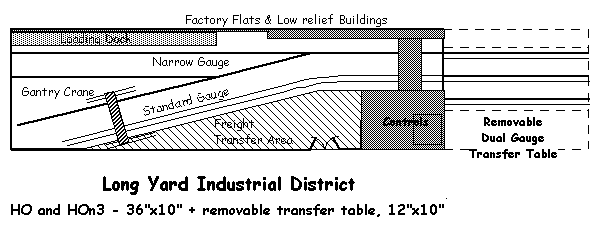
Long Yard Industrial District is a variation on the Walkley/Inglenook theme, showing another way to use the idea. It’s a dual-gauge layout, with the Walkley sidings done in narrow gauge (HOn3 or OO9) and a standard gauge interchange track sharing the gantry crane. A dual-gauge transfer table (traverser) offstage keeps things moving from track to track. Long Yard thus provides all the shunting fun of the Walkley/Inglenook concept, plus additionally allows transfers from narrow to standard gauge to be featured–all in less than three square feet!
And for those whose tastes run to creating intricate dual-gauge trackwork, Long Yard Industrial District 2.0 (below) provides a perfect opportunity to show off your craftsmanship in a form that you can carry with you! The standard gauge trackage has been considerably expanded in this version, and there’s even a dual-gauge crossing to provide a satisfying clickety-clack as both standard and narrow gauge cars run over it. Note that the transfer table (traverser) now forms part of a runaround capability on the standard gauge.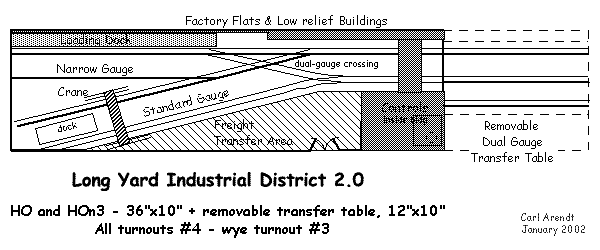
Proof That Size is Important

The uncontrollable Emrys Hopkins provides a dramatic contrast between “full-size” rolling stock and tiny Gn15 “critters” in Gneiss Junction, an interchange between a a15″ gauge line and a metre-gauge line, both in G scale. Needless to say, the plan would also work fine in On30 or On18 (O16.5 or O9) or HOn30 (OO9), alongside standard gauge track in these sizes. As drawn, this layout is 60″x9″ (150×23 cm).
Emrys remarks that this plan is “a variant of one of your existing plans [Dumping Ground Tramway, by Terry Allen], inspired by the arrival of a G-scale U.S. boxcar courtesy of Chris Gilbert. It’s a simple interchange switching layout, but the boxcar gives emphasis to the small size of the 15″ gauge equipment — and this isn’t even a standard gauge car!”
In operation, the Gn15 “train” arrives from the fiddle yard, the loco runs around the train and shoves the appropriate cars into the interchange siding. Later it collects the empties, reassembles everything, and heads back into the fiddle yard. A simple operation, but visually dramatic in contrast to the bulk of the large boxcar.
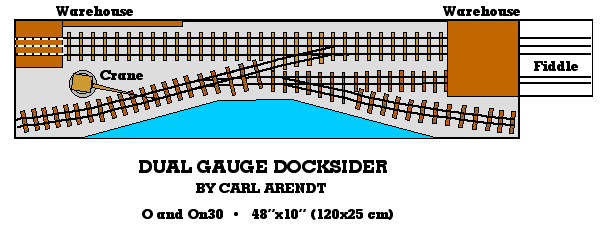
For those who want a dual-gauge “look” to their On30 layouts, yet have very little room for standard-gauge O trains, the Dual Gauge Docksider provides an interesting and easy-to-build micro layout solution. It represents a small 30-inch wharfside switching raiilroad that connects with a branch of Your Local Mainline. There’s even a stretch of dual-gauge trackage in full view, to show off the size differences between the Big Trains and our narrow-gauge concoctions.
Trackwork is designed around Peco On30 track and turnouts (points). One of the turnouts will have to be remounted on longer ties (sleepers) to accommodate an extra rail for standard gauge track. Your reward for that bit of effort is an appealing dual-gauge switch and length of track, without pain! You’ll want at least one standard-gauge car to roll from the fiddle yard to the warehouse at the far end, where it can be loaded/unloaded and returned to the “outside world” (represented by the fiddle yard).
The 30-inch gauge trackage is pretty much an Inglenook style switching layout (and puzzle), but to make things a little more interesting we’ve placed the dockside crane on the switching lead (head shunt). As a result, cars or wagons will need to be spotted by the crane for unloading, and they’lll have to be marshalled on the opposite end of the locomotive in the fiddle yard… and of course, they’ll present an ever-fascinating bottleneck to shunting progress.
Rolling stock, besides the odd standard-gauge car, can be any of the small On30 locomotives available (there are more arriving every day from Bachmann and many other suppliers), and a batch of 14- to 16-foot cars (wagons) such as those supplied by Chivers or scratchbuilt by you.
How is the standard gauge switched? There are several choices you can make: (1) Use the narrow-gauge engine to spot standard-gauge cars, with some adjustment in coupling arrangements; (2) Install a working capstan rig for rope switching; or (3) scratchbuild a tiny standard-gauge gas or electric loco to switch the waterfront. Your choice.
All in all, this small bookcase switching layout can offer you some interesting modeling challenges and good scenic possibilities, as well as considerable scope for operating fun!
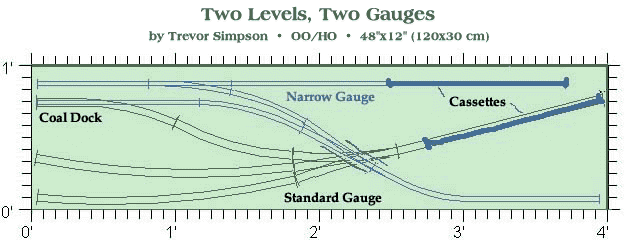
Trevor Simpson has investigated a way to add additional operating fun to a simple layout such as “Morna Yard”, which provides three sidings via a three-way turnout (points) to form an Inglenook switching pattern. This arrangement forms the lower level of Two Levels, Two Gauges. By layering a second tier, Trevor uses very little more real estate to add a second gauge and doubles the operating fun!
In Trevor’s words, “The upper level adds a whole new dimension [pun intended], especially if you have a pair of sidings with one end hidden by a wall or a building so you can have two of my favoured cassettes to change stock. By making the upper level follow the lower you could perhaps make one of the ‘Morna forks’ into a coal loading dock from a narrow gauge upper level (blue) to a standard gauge lower (black).”
Needless to say, if you don’t fancy a narrow-gauge line, you can replace the upper level track with a standard-gauge railway of your choice. And you can arrange the trackage in any of a variety of patterns. See other layouts in this Gallery for ideas — the possible variations are mind-boggling!
With the replaceable cassettes furnishing a nearly endless supply of varied rollng stock, two gauges busily at work at the same time (with two operators, if possible!), and visible work for both levels to do at the coal dock — not to mention the possible shunting puzzles available on both levels — this little 1×4 foot shelf will be a very busy place.
A Dilly of a Layout — Warts and All!
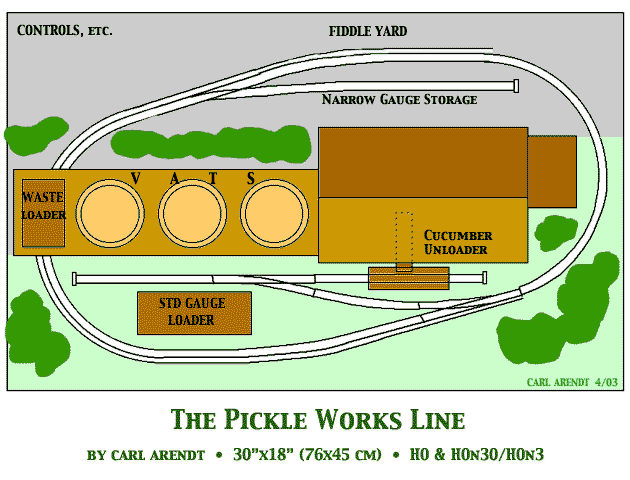
Many years ago, in Model Railroader magazine, Paul Larson wrote about a picturesque, open-air pickle works in the Southern U.S. That article inspired several kits and a good many model structures. The Pickle Works Line is an adaptation of Paul’s basic structure, with the addition of a narrow-gauge agricultural tramway to bring cucumbers to the works — as well as a standard gauge line to haul away the finished product. All in 540 square inches–the size of a wide bookshelf!
Larson described the whole operation this way: “Carloads of cucumbers are unloaded into a bin, then taken from a conveyor and packed, along with salt, into an empty wood vat. A hose is run down a wood chute in the side of the vat and the vat is filled with water. After the cucumbers have been treated in this manner, they’re removed with a long-handled net not unlike a heavy butterfly net. Wheelbarrow-loads of cucumbers are taken up a wood ramp and dumped through a hatch in the top of a pickle car. It’s a fascinating thing to watch because you never know just what will be fished out along with the cucumbers.”
Paul doesn’t mention it explicitly, but somewhere in there the cucumbers convert themselves into pickles. In this version of the pickle works, the narrow gauge tram brings cars of cucumbers (and occasional loads of salt and extra barrels) to the kickback siding beside the roofed part of the structure, where the pickles are dumped onto a conveyor that lifts them into the works. (An operating conveyor would make a delightful model project!)
Every so often a small standard gauge switch engine rumbles slowly into view at the left, comes onstage beneath the “waste loader” chute, and hauls a pickle car or two to the Standard Gauge Loader, where wheelbarrows full of pickles are dumped into the cars through hatches in their tops. This rolling stock is distinctive and different, and has been described in most of the major U.S. modeling magazines over the years (see references below).
The dual gauge trackage may need to be hand laid on full-width ties (sleepers), but there are no complicated turnouts (points) to be constructed. The standard-gauge line is strictly a push-pull operation from the Fiddle Yard to the Loader and return, built as a straighforward third rail addition to the narrow gauge circuit. As pickle cars are closed affairs, there’s no need to empty them in the Fiddle Yard!
Besides doing useful work, the narrow gauge trains can also run round and round to entertain an audience — a very useful capability, especially if you plan to exhibit your work at train shows (and I hope you will!). This line can also be built in On30 or Gn15 scales in roughly the same space, using standard O gauge rails as the “wide gauge”, representing O standard gauge and Gn30 respectively. All curves are 6″ radius, which will require some planning of trucks (bogies) and coupling methods in the standard gauge portion. Perhaps it could be a trolley line, using work trolleys?
For something quite different, yet totally authentic and interesting, the Pickle Works Line is hard to beat. Think about it next time you bite into a plump hamburger or order a Reuben sandwich.
Where to find more information: Paul Larson’s original “Pickle Works” article was published in Model Railroader for January 1955, and another works article ran in February 1961. Pickle car plans and construction articles ran in MR in July 1936 and November 1956; in Railroad Model Craftsman in June 1949, September 1951, and March 1957; in the NG&SL Gazette in Sep/Oct 1978 and Mar/Apr 1979; and in Model Railroading in December 1988.
Continue to Page 2 of “Dual Gauge Layouts”